
The Next Chapter in Global FinOps: Azure China
Intelligent FinOps Platform • Newsletter • Azure Edition
Issue on Sovereign Cloud
For years, Azure China has stood as one of the most strategically significant regions in the global cloud landscape. For multinational enterprises extending their footprint across the border, operating it alongside a global estate has come with a distinct set of challenges. Billing formats follow local conventions. Tagging taxonomies don't automatically travel across sovereignty boundaries. And the management tooling that global teams rely on elsewhere often stops at the edge of the region.
That changes today. We are thrilled to announce that Azure China (21Vianet) is now officially integrated into the Finomics platform managed with the same depth and rigor as every other cloud in our ecosystem. In this issue, we unpack why this matters, how we built it, and what it unlocks for teams managing spend across China's sovereign cloud footprint.
1. The Azure China Landscape
A Physically Separated Cloud — Not Just a Region
Azure China is not simply a region within the global Microsoft Azure footprint. It is a physically and logically separated instance of Azure services, hosted entirely within mainland China and operated under license by Shanghai Blue Cloud Technology Co., Ltd. (21Vianet). It has its own identity plane, its own portal, its own APIs, and — critically for FinOps teams — its own billing system denominated in RMB.
Data Sovereignty as a First Principle
Operating in this region demands a level of compliance and precision that is virtually unparalleled on the global stage. The Multi-Level Protection Scheme (MLPS 2.0), combined with the Cybersecurity Law, the Data Security Law, and PIPL, mandates strict data residency and auditability. In practical terms, data cannot cross the border — and neither can most of the management and telemetry tools that global enterprises rely on elsewhere.
The Complexity Gap
The result is a well-documented “blind spot” for global finance and engineering leaders. Spend in China typically shows up as a lump-sum line item on a local invoice, disconnected from the tagging, chargeback, and unit-economics frameworks that govern the rest of the enterprise. Fragmented billing, currency mismatches, and hidden dashboards combine to produce something close to zero cost visibility at exactly the moment when workloads in China are scaling rapidly.
The Scale of the Blind Spot
For a mid-market global enterprise, Azure China spend routinely lands in the $3M–$7M range annually — yet is often managed through spreadsheets and monthly PDF invoices. The Finomics team observed customers where more than 60% of China cloud spend was untagged, unattributed, and effectively unmanaged prior to integration.
2. The Finomics Integration
The New Standard for Sovereign Cloud Governance
Rather than bolting Azure China on as an afterthought, we rebuilt the relevant layers of the Finomics platform to treat it as a peer to AWS, GCP, OCI, Alibaba and global Azure. The 21Vianet billing feeds now flow into the same ingestion pipeline, are normalized against the same global schema, and surface through the same workflows your teams already use.
Seamless, Configuration-Free Implementation
We introduced what we call Dynamic Cloud Provider Support — a presentation and metadata layer that automatically adjusts branding, provider logos, service naming, currency display, and region labels depending on the account context. No manual reconfiguration. No forked dashboards. Onboard a 21Vianet subscription and the UI adapts in real time.
Key Takeaways
- Unified schema: 21Vianet billing is normalized into the same Finomics data model as every other provider.
- Dynamic UI: logos, labels, and currency adjust automatically based on subscription type.
- No parallel deployment: a single Finomics tenant covers both global Azure and Azure China.
- Compliant architecture: data handling aligns with MLPS 2.0 and residency requirements.
3. Feature Deep Dive
Integration is only the beginning. The real value sits in the purpose-built capabilities now available for Azure China workloads.
Azure China Spend Predictor
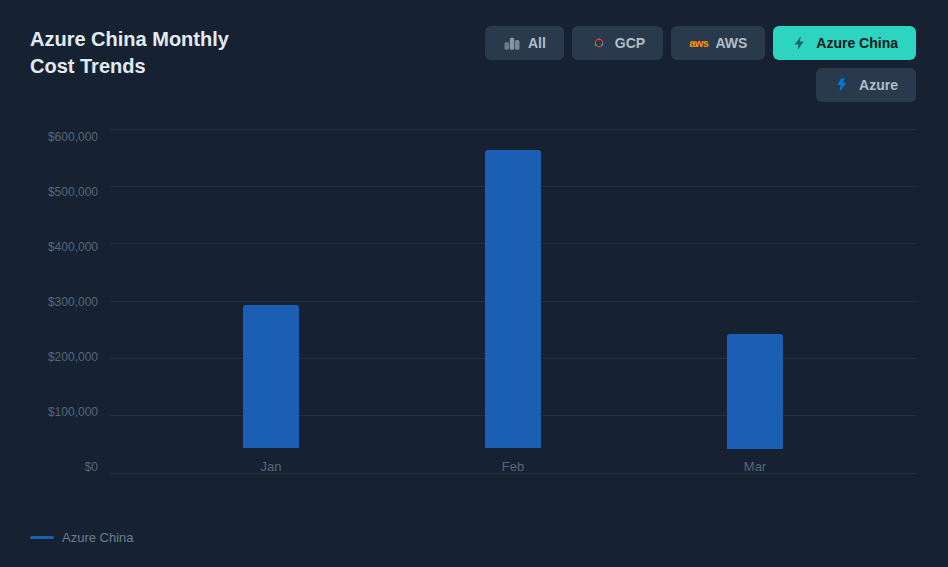
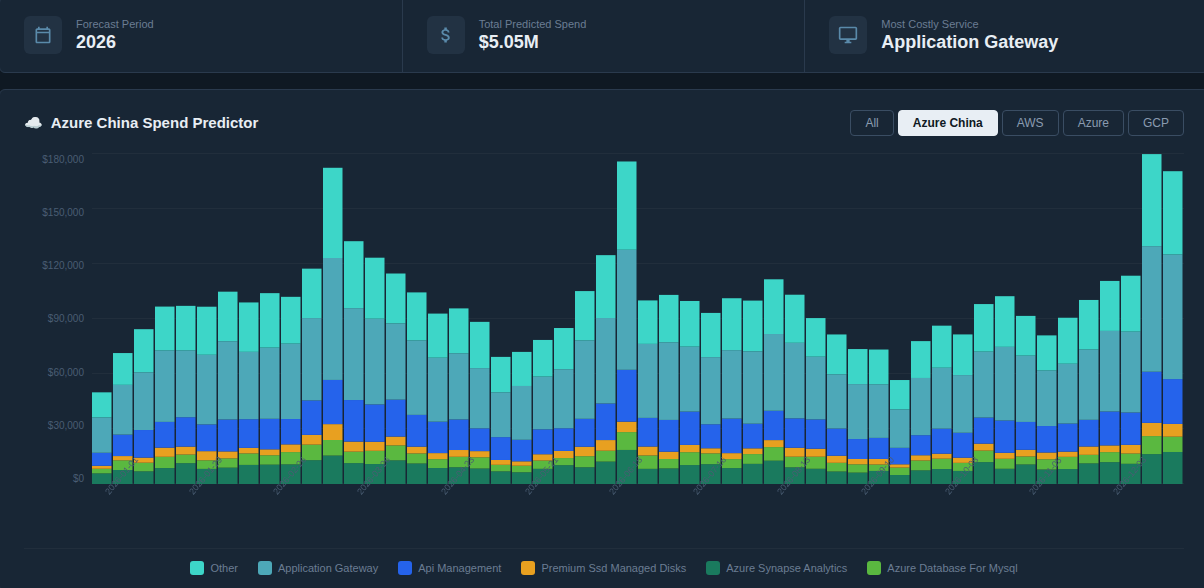
Our forecasting engine, now trained on 21Vianet-specific consumption patterns, delivers 95% forecast accuracy on a yearly horizon. Take, for example, a recent retail client whose weekly spend fluctuated between $90K and $150K before a seasonal campaign pushed the February peak to $550K. Guided by Predictor signals and targeted recommendations, the team successfully governed that spend down to $350K in March—achieving a 36% reduction in just 30 days without a single workload outage.
Total Attribution: Ownership Across Every Department
Every dollar (or yuan) of spend can now be attributed along the same three axes used across the rest of the Finomics estate. Drill from corporate rollup to department to individual project, then pivot back up — without leaving the page.
Service & Resource Breakdown
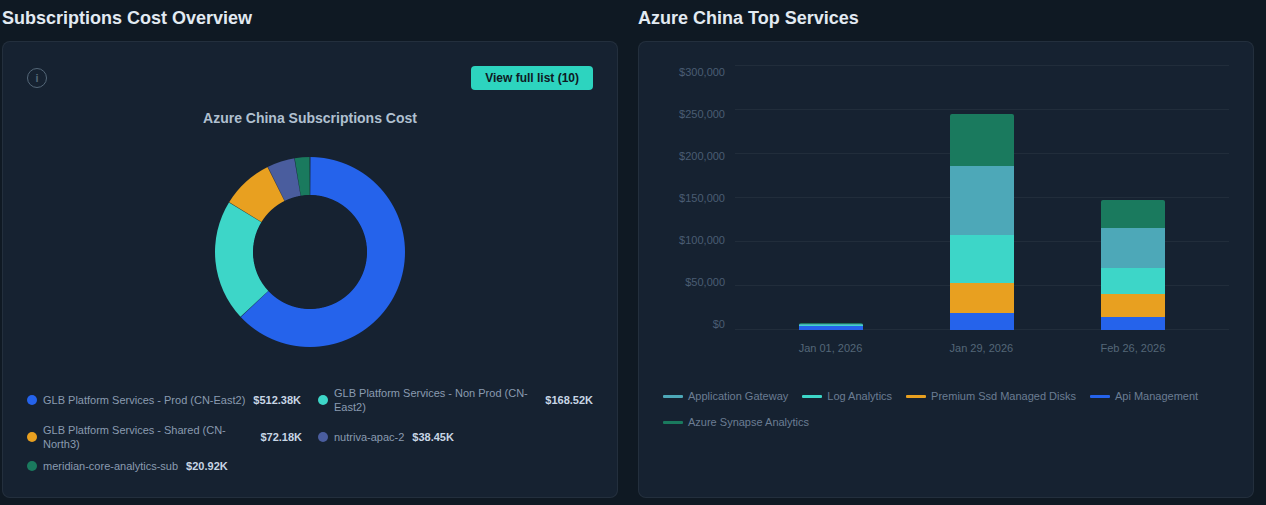
The platform surfaces deep visibility into the services that dominate Azure China bills. In most tenants, approximately 70% of spend concentrates in a handful of services:
- Virtual Machines — compute, the single largest line item
- Azure Kubernetes Service (AKS) — increasingly the default runtime for modern workloads
- Application Gateway — traffic ingress, often over-provisioned
- SQL Databases — with tier and region choices that drive outsized cost
- Data Factory — pipelines where orchestration cost silently compounds
Budgets & Alerts
In a market where Forex swings and rapid scaling can produce mid-month surprises, proactive guardrails are essential. Finomics now supports 21Vianet-aware budget thresholds with multi-channel alerting, helping teams sidestep the classic end-of-quarter “sticker shock” moment.
Regional Analysis
Not all China regions are priced equally. The platform now highlights the highest-charged regions within the China footprint (China North, China East, and their successors) so architects can make residency-compliant choices that are also cost-efficient.
Custom Recommendations
Finomics' recommendation engine has been retrained on the 21Vianet instance catalog and pricing model, producing rightsizing and idle-resource recommendations that reflect the actual SKUs available in-region — not a translated global equivalent.
4. Strategic Impact & Governance
The Unified Lens Dashboard
Perhaps the most strategically significant deliverable is the Unified Lens Dashboard — a single pane that renders Global Azure and Azure China spend side by side. For the first time, a global FinOps lead can compare a workload running in North Europe against its a workload in China East, in the same currency-normalized view, with the same tagging taxonomy, and with the same KPIs.
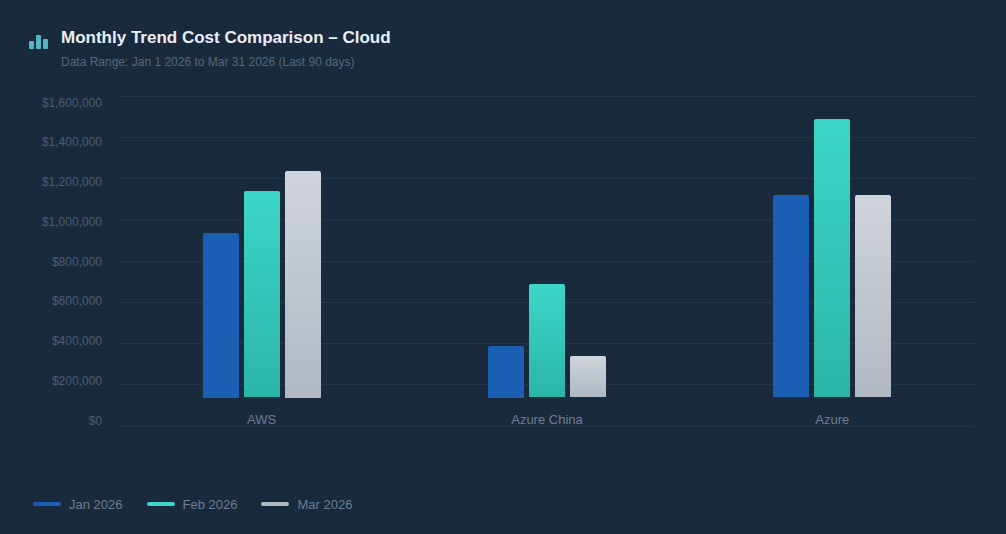
From Regional Complexity to Strategic Advantage
The bottom line: Azure China no longer has to be the unknown quarter of your cloud portfolio. With Finomics, the same FinOps discipline that governs your global estate now extends cleanly across the Great Firewall.
Key Takeaways
- One dashboard, two clouds: global Azure and Azure China, side by side.
- Measurable outcomes: 36% peak-spend reduction achieved in 30 days on real workloads.
- Forecast-grade confidence: 95% accuracy on 30-day 21Vianet spend projections.
From Regional Complexity to Strategic Advantage
Sovereign clouds like Azure China no longer have to sit outside your FinOps discipline. By normalizing localized billing, honoring residency boundaries, and extending the same visibility framework across every environment, Finomics turns regulated geographies into fully governed, fully observable parts of your cloud estate.
Finomics Team
FinOps Insights Team
Cloud cost optimization, SaaS spend intelligence, and FinOps product insights from the Finomics team.
Frequently Asked Questions
Everything you need to know about this topic.
Related Insights
Discover more cloud financial intelligence.